

By Ewere Okonta, PhD
08037383019
eob.org.ng
From transparent admissions to strategic partnerships, the Vice Chancellor is proving that transformational leadership does not always need a microphone.
There is a kind of leadership that announces every move before it is made. It speaks loudly, celebrates every achievement and ensures that everyone hears about what is being done.
Then there is another kind, the leadership that simply gets to work.
It plans quietly, negotiates strategically, makes calculated decisions and allows the results to speak for themselves.
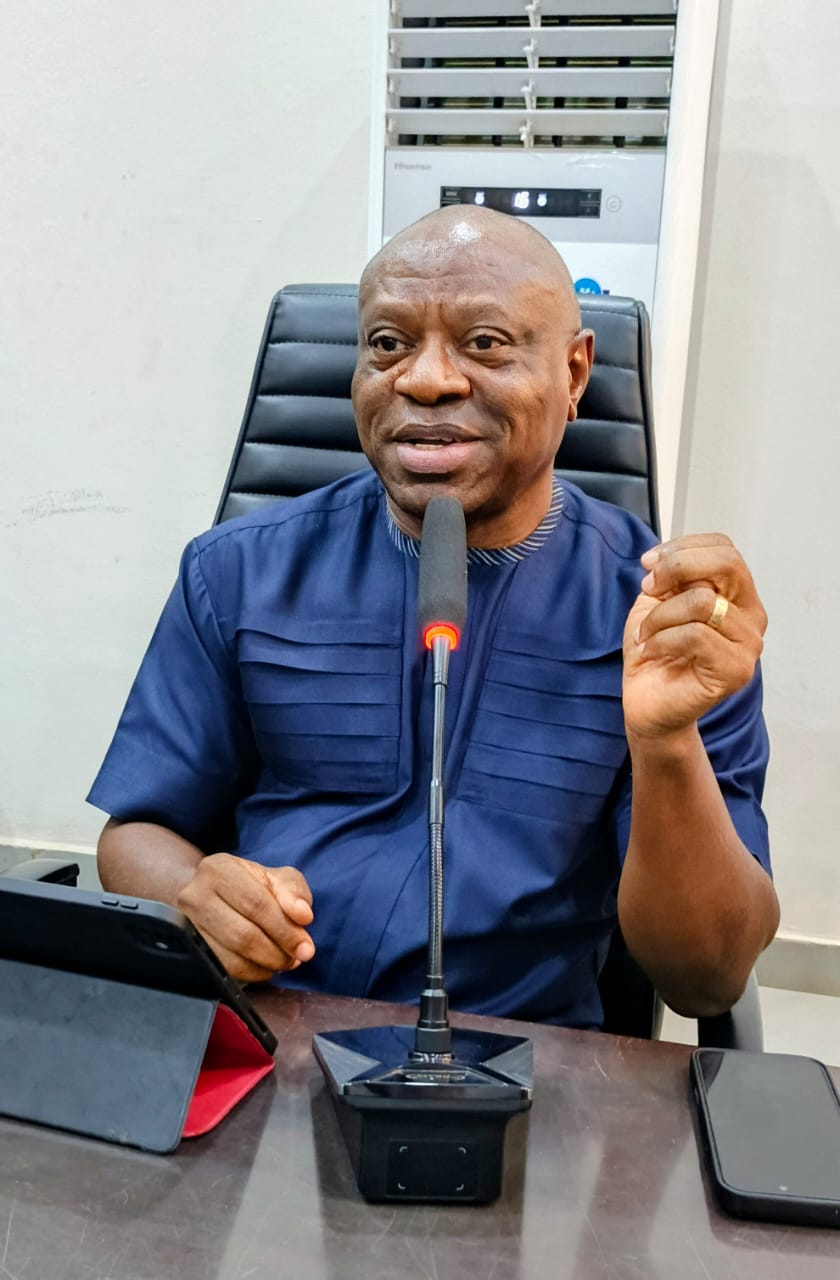
At the University of Delta, Agbor (UNIDEL), that appears to be the emerging leadership signature of the Vice Chancellor, Professor Erich Eboh.
Since assuming office, Prof. Eboh has increasingly demonstrated that institutional transformation does not necessarily require constant publicity. His emerging philosophy appears simple: do more, achieve more and let the results make the noise.
That philosophy is finding expression in his “Project RAISE UNIDEL Higher” strategy, which is gradually becoming more than a slogan. It is evolving into an institutional vision.
THE ADMISSION THAT NOBODY SAW COMING
Perhaps nowhere has this quiet approach generated greater excitement than in the university's recent admission exercise.
Nobody saw it coming.
Then, suddenly - boom!
Qualified prospective candidates began receiving admission offers based on merit. For many stakeholders, the significance was not merely that candidates were admitted, but that the process was conducted transparently and on merit.
Indeed, many have described it as one of the most transparent admission exercises since the creation of the university.
At a time when admission into higher institutions can generate anxiety and uncertainty among parents and candidates, UNIDEL's approach has offered many families a refreshing experience.
As the admission exercise approaches completion, the Vice Chancellor has also maintained that no qualified candidate should be left behind, subject to the extant rules and regulations of the Joint Admissions and Matriculation Board (JAMB) and the University's Admission Board (UAB).
That position is important because it demonstrates that the administration is not promising admission to everyone, but fair consideration for qualified candidates within established regulatory frameworks.
WHEN ADMISSION BECOMES A FAMILY CELEBRATION
The real impact of this process is perhaps best understood through the experiences of individual families.
Take Dr. Osagie from Benin, for example. His two children had applied to study in the Faculty of Management Sciences and the Faculty of Environmental Sciences. He was already preparing for them to travel to UNIDEL for the Post-UTME exercise.
Then came the surprise.
The children checked their portals and discovered that they had already been offered admission into their desired courses.
When Dr. Osagie called to share the news, his excitement was unmistakable. He had no lengthy analysis to offer, only prayers for Prof. Eboh and his team.
That is where institutional transformation becomes personal. A policy decision made in an administrative office had translated into relief and joy in a parent's home.
The experience was similar for Mr. Chuks Emegha of Agbor, whose son was offered admission to study Medicine and Surgery at UNIDEL.
For a parent, such an admission represents much more than a university placement. It represents hope, sacrifice, expectation and the beginning of a child's professional journey.
Then there is the remarkable case of Comrade Perey from Warri, whose two daughters were offered admission to study Law and Nursing Sciences, respectively.
What made the family's experience particularly interesting was that they were initially unaware of the admissions. They only received the news when the business centre operator who helped facilitate the process came to inform them.
These are more than admission stories. They are stories about trust.
And when a university builds trust through a transparent and merit-based process, its reputation begins to grow organically.
LESS NOISE, MORE RESULTS
This is perhaps what increasingly distinguishes the Eboh leadership style.
The Vice Chancellor does not appear obsessed with announcing every move. He appears more interested in making the move.
He negotiates. He builds relationships. He explores opportunities. He engages stakeholders and attempts to convert possibilities into institutional value.
In many respects, this resembles the approach of a modern corporate CEO: build strategic relationships, negotiate intelligently, secure valuable partnerships and position the organisation for sustainable growth.
A university may be an academic institution, but it is also a complex organisation that must compete for talent, partnerships, funding, technology, visibility, innovation and relevance.
Prof. Eboh appears to understand this reality.
That may explain why UNIDEL's conversations are increasingly extending beyond classrooms and examinations to include technology, entrepreneurship, digital transformation, research, international collaboration, infrastructure and strategic partnerships.
THE CONFIDENCE EFFECT
There is another important dimension to this emerging transformation: confidence.
When stakeholders begin to trust an institution, they become more willing to invest in it.
Parents become more confident about sending their children there. Prospective students become more interested. Corporate organisations become more willing to collaborate. Foundations and highly spirited individuals begin to see the university as a credible platform for impact.
That appears to be happening gradually around UNIDEL.
And this may be one of the most significant achievements of strategic leadership: making people believe enough in a vision to invest their resources in it.
“Project RAISE UNIDEL Higher” will ultimately be judged, not by the elegance of its name, but by the results it produces.
Raising a university higher requires more than slogans. It requires innovation, partnerships, funding, discipline, transparent systems and courageous decision-making.
The recent admission exercise is therefore only one part of a much larger picture.
The goal should not simply be to make UNIDEL bigger, but to make it better, more competitive, innovative, technologically driven, research-oriented and attractive to students, scholars, investors and strategic partners.
THE WORK HAS ONLY BEGUN
Success, however, creates a new responsibility.
When parents begin to trust the admission process, they expect the same transparency elsewhere. When students believe that merit will be rewarded, they expect that principle to remain protected. When corporate organisations and foundations begin to invest, they expect professionalism, accountability and measurable impact.
The challenge for Prof. Eboh is therefore not merely to surprise stakeholders once. It is to institutionalise the systems that make such successes sustainable.
That is the real test of leadership.
Universities are not transformed overnight. They are transformed through hundreds of decisions, strategic conversations, partnerships, investments and painstaking administrative processes.
Some are visible.
Many are not.
But eventually, they accumulate into institutional change.
And perhaps that is why Prof. Eboh continues to surprise stakeholders.
While some leaders spend considerable time telling people what they intend to do, the Eboh administration appears increasingly focused on doing what needs to be done.
Quietly. Strategically. Deliberately.
Then the results arrive.
An admission notification appears on a student's portal. A parent receives unexpected good news. A child secures admission to study Medicine and Surgery. Two sisters receive offers to study Law and Nursing Sciences. A corporate organisation decides to partner with the university. A foundation sees UNIDEL as a platform for impact.
And suddenly, people begin to ask:
“What exactly is going on at UNIDEL?”
Perhaps the answer is simple:
Somebody is working.
SUPPORT THE VISION
Leadership is never a one-man project.
No Vice Chancellor, however innovative, can transform a university alone. Lecturers, students, administrators, alumni, parents, corporate organisations, government and the wider community all have roles to play.
For those who care about the future of UNIDEL, the responsibility should therefore go beyond applause.
We must support good initiatives, offer constructive criticism where necessary, celebrate genuine progress, demand accountability and, above all, pray for the leadership of the university.
Prof. Erich Eboh has entered an environment where expectations are high and scrutiny is inevitable. But if the early signs are anything to go by, his administration appears determined to keep pushing.
More innovation. More partnerships. More opportunities. More transparency. More strategic thinking. More value. And ultimately, a higher UNIDEL.
The publicity may not always come first.
But perhaps that is precisely the point.
Let the work continue. Let the results speak.
If Prof. Eboh sustains this momentum; quietly negotiating, strategically innovating and relentlessly pursuing opportunities for the university, then “Project RAISE UNIDEL Higher” may eventually become more than an administrative slogan.
It may become a defining chapter in the story of the University of Delta.
For now, all UNIDEL stakeholders owe the Vice Chancellor and his team not only applause, but support, constructive partnership and prayers for the wisdom, strength and courage to continue doing more, and raising UNIDEL higher, without making unnecessary noise.
Dr Ewere Okonta is the CEO of EOB Media. He writes from the Department of Business Administration, University of Delta, Agbor.


Comments (0)
No comments yet. Be the first to share your thoughts!
Leave a Comment