

By Ewere Okonta, PhD
08037383019
eob.org.ng
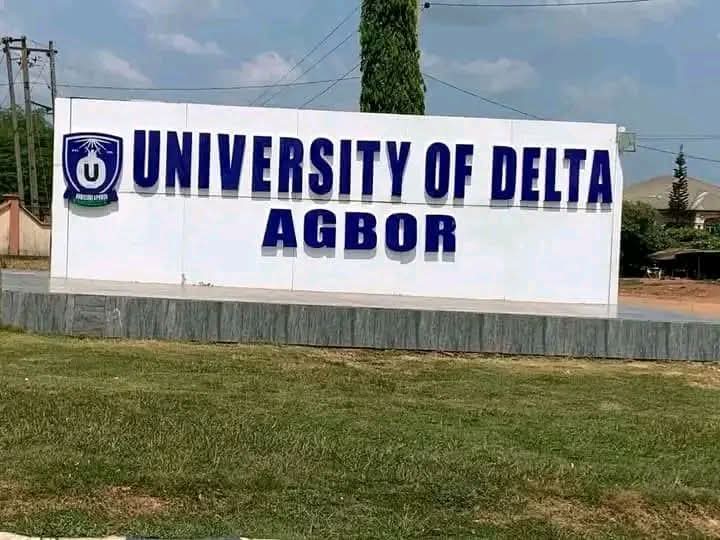
Something remarkable is happening at the University of Delta, Agbor (UNIDEL).
More than 12,000 prospective candidates reportedly chose the University of Delta as their preferred institution in the 2026/2027 JAMB admission cycle.
Read that again.
Over 12,000 candidates chose UNIDEL.
For a university that became a full-fledged institution only in 2021, that figure is not just impressive; it is a powerful statement about the changing perception of the institution among young Nigerians seeking university education.
The big question, therefore, is simple: Why UNIDEL?
Why are thousands of young Nigerians, including candidates who have several universities to choose from, increasingly looking in the direction of Agbor?
The answer is not far-fetched.
A Young University with an Old Foundation
To understand the growing attraction of UNIDEL, one must first understand its history.
The University of Delta, Agbor, was established in February 2021 by the Delta State Government, following the transformation of the former Delta State College of Education, Agbor, into a full-fledged university. The institution itself has a much older history, having originated as a College of Education established in 1979 by the former Bendel State Government. (University of Delta)
In other words, UNIDEL may be young as a university, but it did not emerge from a vacuum.
It inherited decades of educational experience, infrastructure, personnel and institutional history, and has since been repositioned to compete in the increasingly competitive Nigerian university landscape.
Located along the Warri/Agbor Road, Agbor, Delta State, the university sits in a relatively serene and academically friendly environment in Ika South Local Government Area. (University of Delta)
And perhaps one of the most interesting things about UNIDEL is that it is not confined to one location.
Three Campuses, One University
UNIDEL operates a distinctive three-campus system comprising the main campus at Agbor, the Owa-Oyibu Campus, and the Owa-Alero Campus. (University of Delta)
This multi-campus arrangement gives the university an interesting geographical and academic spread.
The main Agbor campus remains the institutional hub, while the Owa-Oyibu and Owa-Alero campuses provide additional academic spaces and opportunities for students.
For many admission seekers, this matters.
A university is no longer judged merely by the name on its gate. Students and parents want to know where they will learn, the kind of programmes available, the facilities they will have access to, the quality of teaching, the institution's digital capacity, its academic culture and, increasingly, whether the university is preparing them for the world beyond graduation.
UNIDEL appears to understand this changing reality.
A Broad Academic Choice
Another reason prospective students are looking towards UNIDEL is the institution's expanding academic portfolio.
The university's official profile states that it now operates 12 faculties across its three campuses, with disciplines spanning areas such as Agriculture, Arts, Education, Engineering, Law, Computing, Sciences, Management and Social Sciences, as well as medical and related fields. (University of Delta)
The breadth is significant.
A young person interested in Law can find a pathway at UNIDEL. So can someone interested in Engineering, Computing, Business Administration, Entrepreneurship, Accounting, Political Science, the Sciences, Agriculture, Education, Arts or other professional and emerging disciplines.
The Faculty of Engineering, for instance, describes itself as one of the university's pioneer faculties and says it currently runs NUC-approved programmes supported by laboratories, workshops, classrooms and technical facilities. (Delta Engineering)
The Faculty of Management Sciences also offers programmes including Accounting, Banking and Finance, Business Administration, Economics, Entrepreneurship and Business Innovation, Mass Communication, Psychology, Sociology, Criminology, Political Science, Public Administration and International Relations. (University of Delta)
The message is clear: UNIDEL is expanding the choices available to students.
The Stella Chiemeke Foundation
Every successful institution has people who lay the foundation.
At UNIDEL, one name that cannot be ignored in the institution's early history is that of Prof. Stella Chiemeke, the pioneer Vice-Chancellor.
As the first Vice-Chancellor, Prof. Chiemeke led the university during its formative years when the institution was still establishing its identity, systems, academic structures and institutional culture.
Those early years were crucial.
Building a university from an inherited college structure is not the same thing as managing an already-established university.
There were structures to develop, programmes to strengthen, campuses to coordinate, staff to mobilise, students to guide and a new institutional identity to establish.
The foundation laid during that period has become part of the platform upon which the university's subsequent growth is being built.
It is therefore difficult to tell the story of UNIDEL's rapid evolution without acknowledging the pioneering administration of Prof. Chiemeke.
Enter Professor Eric Eboh
Then came another chapter.
On April 28, 2026, Prof. Eric Chiedum Eboh assumed office as the second Vice-Chancellor of the University of Delta.
And he came with a clearly articulated agenda.
Project RAISE UNIDEL Higher.
RAISE represents five strategic pillars: Research and Innovation; Academic Excellence; ICT Optimisation; Staff Professional Development and Welfare; and a conducive Environment for staff, students and other stakeholders. (University of Delta)
That strategy is particularly significant because today's university student is different from the university student of two decades ago.
The contemporary student is digital.
The world of work is digital.
Research is increasingly digital.
Teaching and learning are digital.
Business is digital.
Communication is digital.
And employers increasingly want graduates who can do more than simply present certificates.
They want people who can think, innovate, communicate, create, analyse data, use technology and solve problems.
That is why the ICT component of Project RAISE is particularly relevant.
UNIDEL's stated mission already emphasises digital transformation, quality education and research, practical skills, employability and global competitiveness. (University of Delta)
The New Generation of UNIDEL
This is where the 12,000-candidate story becomes even more interesting.
Perhaps the candidates are not simply choosing a university.
Perhaps they are choosing a direction.
They are choosing an institution that increasingly presents itself as young, ambitious, technology-conscious and determined to compete.
They are choosing an institution where new academic programmes are being developed and where existing programmes are being strengthened.
They are choosing an institution that has demonstrated an appetite for innovation.
And they are choosing an institution whose current administration is openly talking about research, innovation, academic excellence, digital transformation, staff development and a conducive learning environment. (University of Delta)
That is a compelling proposition to a generation of young people who want their university education to translate into something tangible.
Beyond the Certificate
Perhaps the most important reason candidates are looking towards UNIDEL is the changing meaning of university education.
Today, parents do not only ask: "Will my child graduate?"
They increasingly ask:
What will my child learn?
What skills will my child acquire?
What kind of environment will my child study in?
Will the university prepare my child for the labour market?
Will my child have access to technology?
Will the university encourage innovation and entrepreneurship?
Will the institution give my child opportunities beyond the classroom?
These are legitimate questions.
And UNIDEL's stated institutional mission speaks directly to many of them, particularly through its emphasis on practical skills, self-reliance, employability, research and digital transformation. (University of Delta)
The university's growing emphasis on technology and innovation also fits neatly into this new educational reality.
The Power of Perception
There is another factor that cannot be ignored: perception.
Universities grow not only through buildings and programmes but through public confidence.
When students begin to talk positively about an institution, when parents recommend it, when graduates become ambassadors, when academics produce research and when the university consistently attracts attention, a new institutional narrative begins to emerge.
The reported 12,000-plus applications are therefore significant because they suggest that UNIDEL's name is increasingly entering the consciousness of admission seekers.
This is particularly remarkable considering how young the university is.
In 2023/2024, for example, the university announced that more than 6,000 people had applied for admission, according to a report published on its official website. (University of Delta)
If the reported figure of more than 12,000 candidates for the 2026/2027 cycle is confirmed, it would represent a remarkable increase in demand within just a few admission cycles.
That is not a small development.
It is a signal.
Why UNIDEL?
So, why are more candidates choosing UNIDEL?
The reasons may be summarised simply.
First, location. UNIDEL is situated in Agbor, with campuses extending to Owa-Oyibu and Owa-Alero, giving it a distinctive multi-campus presence. (University of Delta)
Second, academic diversity. The university has expanded its academic offerings across a wide range of disciplines and now describes itself as having 12 faculties. (University of Delta)
Third, infrastructure and academic expansion. The institution is investing in and developing facilities necessary to support teaching, learning, research and professional training.
Fourth, technology. From digital transformation in its institutional mission to ICT optimisation under Project RAISE UNIDEL Higher, technology is increasingly positioned at the centre of the university's development strategy. (University of Delta)
Fifth, leadership. The pioneering foundation laid under Prof. Stella Chiemeke has been followed by the strategic development agenda of Prof. Eric Eboh.
Sixth, relevance. The university's focus on research, innovation, skills, employability and entrepreneurship resonates with the needs of today's young people.
And, perhaps most importantly, UNIDEL is becoming a university with ambition.
A University on the Rise
There is something fascinating about watching a young institution grow.
Five years may seem like a short time in the life of a university, but UNIDEL has already moved from being a newly established university to an institution with a recognisable academic identity, multiple campuses, an expanding faculty structure and an increasingly visible presence in the Nigerian higher education space.
Its first convocation has already taken place, and its current administration has declared its intention to take the institution even further through Project RAISE UNIDEL Higher. (University of Delta)
So, when more than 12,000 prospective JAMB candidates reportedly put UNIDEL on their admission radar, perhaps the better question is no longer:
"Why UNIDEL?"
Perhaps the question should be:
"What is happening at UNIDEL?"
The answer is simple.
A university is being built.
A reputation is taking shape.
A new generation of students is beginning to identify with it.
And if the reported 12,000-plus first-choice candidates are anything to go by, UNIDEL is no longer asking Nigeria's admission seekers to notice it.
They are already noticing.
And they are choosing.
UNIDEL.
The University of Delta, Agbor, a young university with a growing reputation and an even bigger ambition.
Dr. Ewere Okonta is the Chief Executive Officer of EOB Media and a member of the Editorial Team of the UNIDEL Newsletter. He is a lecturer in the Department of Business Administration, University of Delta, Agbor (UNIDEL).



Comments (1)
This is a great achievement for Deltans and especially the people of Agbor.
And I will like to contribute to the accademic growth of this insitution. https://www.linkedin.com/in/isioma-sandra-erue-ph-d-b14195268
Leave a Comment