

By Ewere Okonta, PhD
08037383019
eob.org.ng
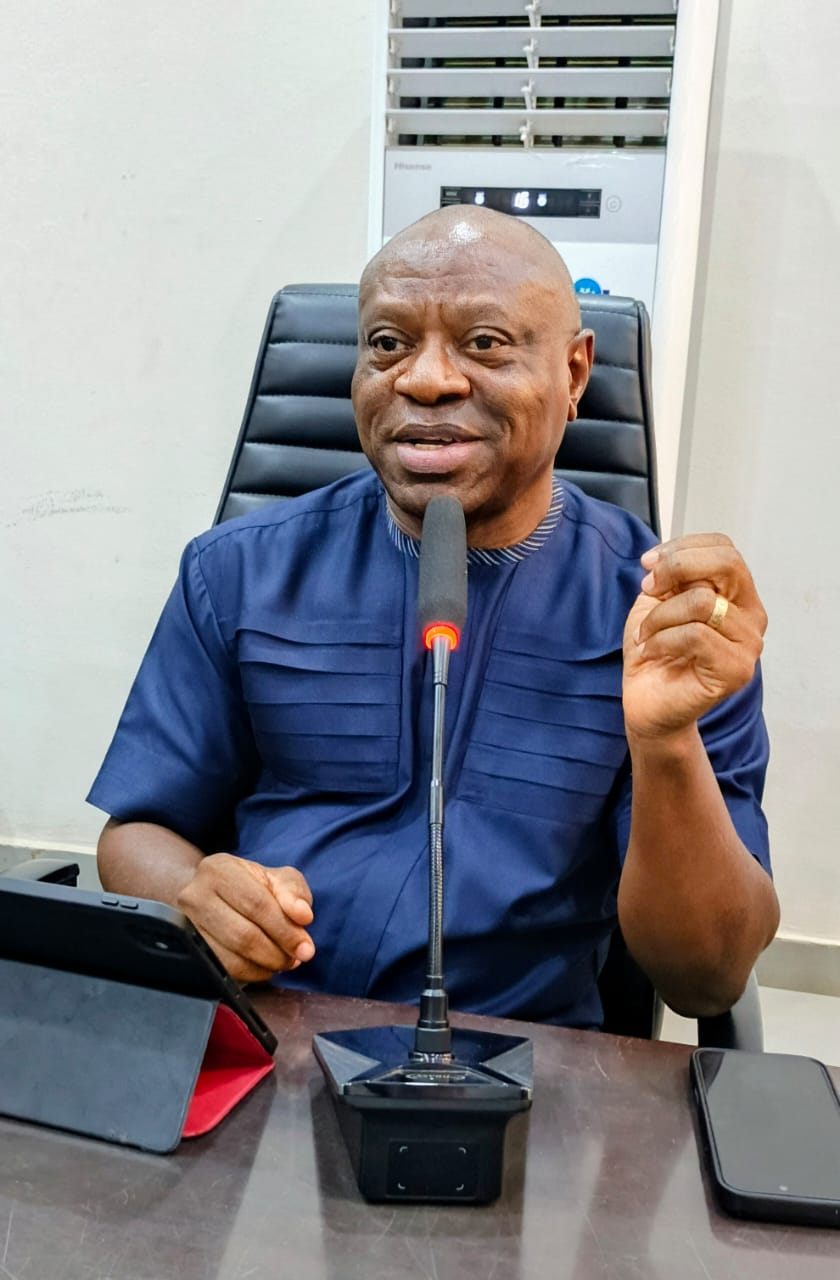
History was made today at the University of Delta, Agbor (UNIDEL), as the Vice Chancellor, Prof. Eric Chiedum Eboh, formally flagged off Operation 3000 Computers, a strategic initiative aimed at bridging the university’s computer deficit and accelerating its digital transformation.
The initiative was unveiled at the University Council Chambers during a stakeholders’ meeting attended by members of the university management, representatives of the Academic Staff Union of Universities (ASUU), Non-Academic Staff Union (NASU), Senior Staff Association of Nigerian Universities (SSANU), Non-Academic Technicians (NAAT), deans, directors, heads of departments, and representatives of the Students’ Union Government.
Addressing the gathering, Prof. Eboh said the stakeholders’ meeting was convened not only to take stock of the university’s progress but also to refresh its collective vision and make a clarion call for all stakeholders to work together to “RAISE UNIDEL Higher.”
According to him, the university’s transformation is anchored on the RAISE UNIDEL Higher strategy, a broad institutional framework designed to reposition the university for greater academic excellence, innovation, digital transformation, infrastructural development, and global competitiveness.
He explained that the “I” pillar of the RAISE UNIDEL Higher strategy represents ICT Optimisation, which seeks to leverage digital technology to transform teaching, learning, research, administration and other aspects of the university’s academic landscape.
Prof. Eboh stressed that achieving this objective requires the deliberate digitalisation of the university’s operations and infrastructure, as well as the collective buy-in and support of the entire university community and other stakeholders.
Digital Transformation Already Underway
The Vice Chancellor commended the UNIDEL Digital Initiative Committee, headed by Dr. Okpakor, for the progress recorded in advancing the university’s digital transformation strategy.
He particularly highlighted the successful digitalisation of the university’s admission process, describing the achievement as a significant step towards building a more efficient, transparent and technology-driven institution.
Prof. Eboh disclosed that since assuming office, his administration had facilitated five digital training programmes aimed at upskilling members of both the academic and non-academic staff, noting that a digitally driven university requires a workforce equipped with the requisite knowledge and competencies.
He further revealed that the university had completed the construction of a digital studio, designed to meet the digital academic needs of the university community while also serving the immediate society.
According to him, the studio is expected to support digital content creation, teaching, learning, research and other technology-driven academic activities.
However, despite these achievements, the Vice Chancellor identified inadequate computer systems as one of the major obstacles standing between the university and the full realisation of its digital transformation ambitions.
“We Need 3,000 Computers”
It was against this backdrop that Prof. Eboh announced the Operation 3000 Computers initiative.
The initiative is a strategic call for individuals, corporate organisations, foundations, philanthropists, alumni, friends of the university and other well-meaning stakeholders to contribute computer systems towards strengthening UNIDEL’s digital capacity.
Prof. Eboh explained that the target is to mobilise 3,000 computer systems for the university, stressing that the initiative is not solely the responsibility of the university management but a collective project requiring the support of all stakeholders.
In keeping with his personal philosophy of leading from the front and leading by example, the Vice Chancellor immediately demonstrated his commitment to the initiative by donating two Dell laptop computers to support Operation 3000 Computers.
The gesture was followed by the Deputy Vice Chancellor, Prof. Patrick Ijeh, who pledged to donate one laptop to the initiative.
The Vice Chancellor subsequently called on other stakeholders to emulate the gesture, urging individuals, corporate bodies, foundations, philanthropists and other organisations to support the university by donating at least one computer system.
He noted that if stakeholders collectively respond to the call, the university would be significantly closer to achieving its target and creating a stronger technological foundation for teaching, learning and research.
A Collective Responsibility
The stakeholders at the meeting expressed their commitment to supporting the university’s digital transformation agenda, recognising that access to adequate computer systems is fundamental to the realisation of a modern university.
The presence of representatives of ASUU, NASU, SSANU, NAAT, the Students’ Union Government and other critical stakeholders underscored the collective nature of the initiative.
For UNIDEL, Operation 3000 Computers goes beyond the acquisition of hardware. It represents a strategic investment in the future of the institution and an important component of the broader effort to build a digitally enabled university.
With the digitalisation of admissions, staff digital training, the establishment of a digital studio and other technology-driven initiatives already underway, the university management believes that closing the computer gap will provide the critical infrastructure required to move these initiatives from promising projects to sustainable institutional transformation.
The flag-off of Operation 3000 Computers therefore marks another significant milestone in the administration’s drive to RAISE UNIDEL Higher, with technology positioned at the heart of its ambition to create a more efficient, innovative, competitive and globally relevant university.
As Prof. Eboh’s administration continues to pursue its transformation strategy, the message from the Council Chambers was clear: the future of UNIDEL must be digital, and everyone has a role to play in building it.
Dr. Ewere Okonta is the Chief Executive Officer of EOB Media and a member of the Editorial Team of the UNIDEL Newsletter. He is a lecturer in the Department of Business Administration, University of Delta, Agbor (UNIDEL).



Comments (0)
No comments yet. Be the first to share your thoughts!
Leave a Comment