

By Ewere Okonta, PhD
08037383019
eob.org.ng
Nigeria's electricity crisis has made reliable power supply an expensive luxury for millions of households and businesses. Between rising petrol prices, generator maintenance and unreliable national grid supply, the search for affordable and sustainable alternatives has become increasingly urgent.
Yet, some of the answers may lie in the ingenuity of Nigerians who are quietly developing solutions within their communities.
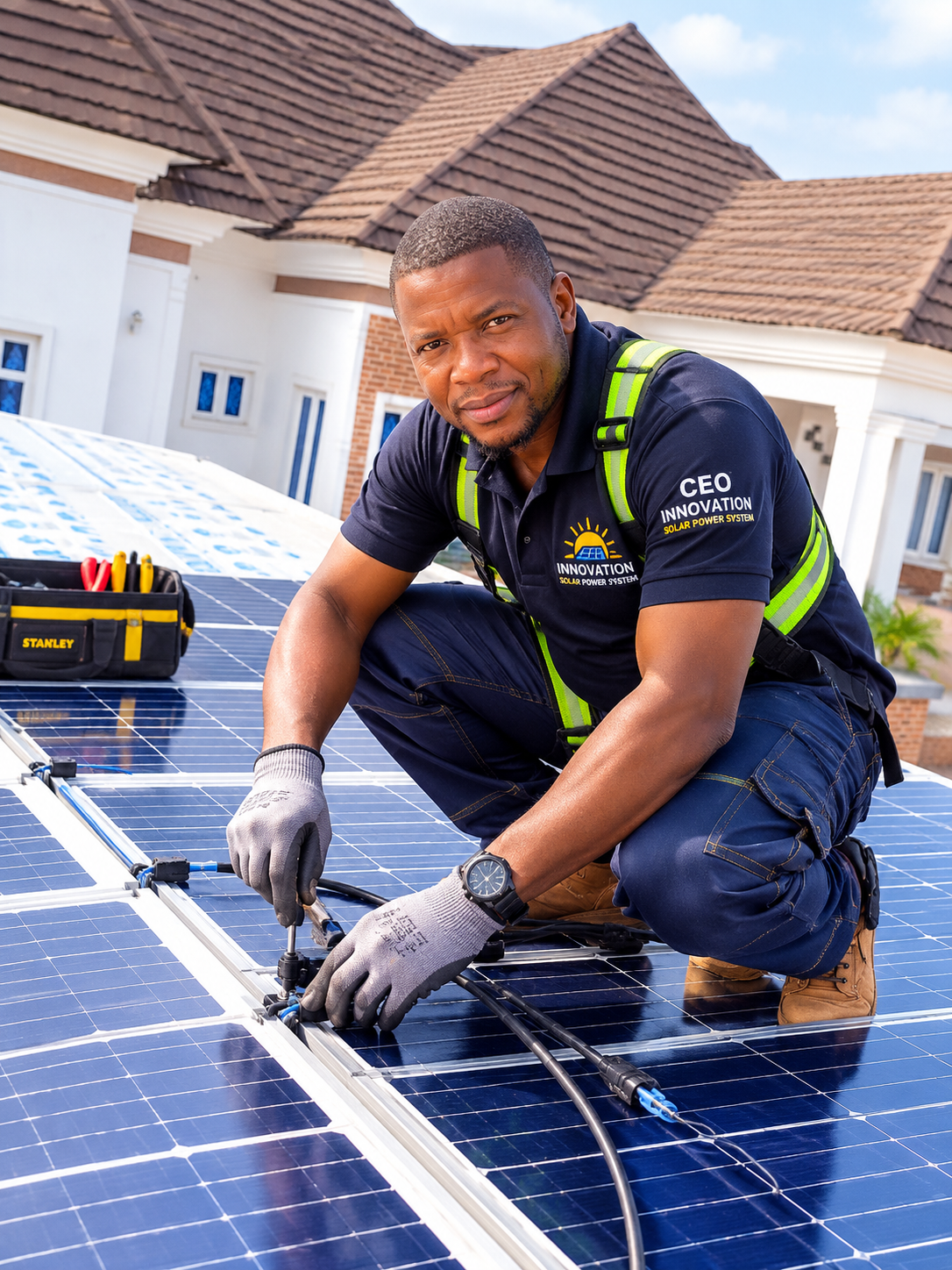
One such individual is Azuka Matthew Okocha, the Ekuku Agbor-born Chief Executive Officer of Innovation Solar Power System, whose entrepreneurial interests and renewable energy innovations deserve attention.
My encounter with Okocha was more than a conversation with an entrepreneur. It was an engaging exchange with a man constantly exploring ideas and possibilities for addressing Nigeria's energy challenges. His ambition is to see households, businesses and industries enjoy dependable electricity through renewable energy, particularly solar, wind and hydropower.
What makes his story interesting is his interest in moving beyond the conventional business of importing and installing solar equipment to exploring indigenous technological solutions.
A Personal Testimony: Four Months Without NEPA and Generator Wahala!
Sometimes, the best way to appreciate an innovation is not through the promises of its creator but through the practical experience of someone who has benefited from it.
For the past four months, I have enjoyed uninterrupted electricity supply in my home, courtesy of the solar power installation undertaken by Innovation Solar Power System.
I am proud to say that I have been practically off-grid, enjoying a welcome escape from the familiar NEPA wahala and generator wahala that have become part of the Nigerian experience.
Consider what this means for an average Nigerian household. The solar installation in my residence has been powering my borehole, three freezers, television and virtually all the household electrical appliances we depend on for our daily comfort and activities.
No incessant search for petrol. No generator noise disturbing the peace of the neighbourhood. No recurring anxiety over fuel prices or the uncertainty of electricity supply from the national grid. More importantly, no constant interruption of household activities because electricity has suddenly disappeared.
This is not an advertisement based on theoretical projections. It is my personal experience with a product installed in my home.
For me, this experience has reinforced an important lesson: renewable energy is no longer merely a conversation about the future. It is a practical solution that is already changing how households can live, work and manage their resources.
Of course, the performance of every solar installation depends on appropriate system sizing, battery capacity, energy consumption and professional installation. But my experience demonstrates what a properly configured solar system can achieve.
Beyond Solar Panels: A Bigger Innovation Agenda
Through Innovation Solar Power System, Azuka is involved in solar packages, inverters, lithium batteries and automated gate systems. However, his ambitions extend beyond supplying and installing renewable energy equipment.
During our discussion, he shared ideas about harnessing solar, wind and hydropower to expand electricity access. Particularly intriguing is his hydropower concept involving electricity generation through borehole water systems, which he hopes to develop further.
Such an idea will require rigorous technical assessment, research and successful commercial testing. Nevertheless, his willingness to explore alternative energy technologies reflects the innovative thinking Nigeria needs.
He believes solar remains particularly attractive to Nigerian households because of its relative affordability, accessibility and maintenance advantages. Wind energy also has potential, although its suitability depends on location, infrastructure and operating costs.
The broader argument is that Nigeria should embrace a diversified renewable energy framework rather than depend exclusively on conventional electricity sources.
The Challenges Facing Indigenous Innovation
Despite his enthusiasm and entrepreneurial drive, Azuka acknowledges that inadequate finance remains a major obstacle to expanding his operations.
He also identifies the preference for foreign products, high import costs, foreign exchange instability and limited access to production facilities as challenges confronting indigenous manufacturers.
His experience raises an important question: How can Nigeria achieve technological independence if local innovators cannot access the resources required to develop and commercialise their ideas?
Innovation requires more than encouragement. It needs investment, technical partnerships, research facilities, quality assurance and access to markets.
Azuka is therefore appealing to investors, government agencies and corporate organisations to support his vision and help move his business beyond its present operational capacity.
A Call for Strategic Support
The Delta State Government has an opportunity to explore partnerships with promising indigenous entrepreneurs through the Delta State Investment Development Agency (DIDA) and relevant entrepreneurship development institutions.
The Office of the Special Adviser on Entrepreneurship Development could also help connect innovators with investors, technical experts and appropriate funding opportunities.
Imagine the economic possibilities of affordable renewable energy solutions for small businesses across Ika land and Delta State. Hairdressing salons, cold-room operators, supermarkets, schools, hospitals, farms and other enterprises could reduce their dependence on petrol and diesel generators, improve productivity and lower operating costs.
Beyond Delta State, the Bank of Industry, development finance institutions, commercial banks, private investors and international development partners should pay attention to the opportunities in Nigeria's expanding renewable energy market.
Support for Innovation Solar Power System should, however, be anchored on proper technical evaluation, business viability, product quality and a sustainable investment framework. This will protect investors while giving indigenous innovation the opportunity to grow.
EOB Media's Position: Give Local Innovation a Chance
At EOB Media, we believe that entrepreneurs like Azuka Matthew Okocha deserve visibility and the opportunity to demonstrate the commercial and developmental value of their ideas.
My four-month experience with his solar installation provides a practical perspective on the possibilities of renewable energy. It has freed my household from the daily frustrations of unreliable grid electricity and generator dependence.
However, the larger conversation must go beyond individual installations. Nigeria needs a deliberate system for identifying, financing, testing and commercialising homegrown technological innovations.
Okocha's vision is ambitious, and some of his proposed technologies still require further development and validation. But ambition backed by research, technical competence and appropriate investment can become an important driver of economic progress.
Innovation Solar Power System is open to partnerships, collaborations, sponsorships and investment opportunities.
The company is located at 15 Odozi Street, Agbor, Delta State, and can be reached through 08064840225 and 09033436754.
Nigeria does not lack people with ideas. What we often lack is the institutional support and investment required to turn those ideas into commercially viable solutions.
Azuka Matthew Okocha is one of the indigenous entrepreneurs worth watching. His journey from Ekuku Agbor into the renewable energy space deserves attention, constructive engagement and the right kind of support.
The future of energy is renewable. Nigeria must look beyond its challenges and begin to invest in the ingenuity of its own people. And sometimes, the next big idea may just be taking shape in our own backyard.
Dr Ewere Okonta is the CEO of EOB Media, a family-values advocate, teacher and writer. He writes from the Department of Business Administration, University of Delta, Agbor.
Comments (0)
No comments yet. Be the first to share your thoughts!
Leave a Comment