

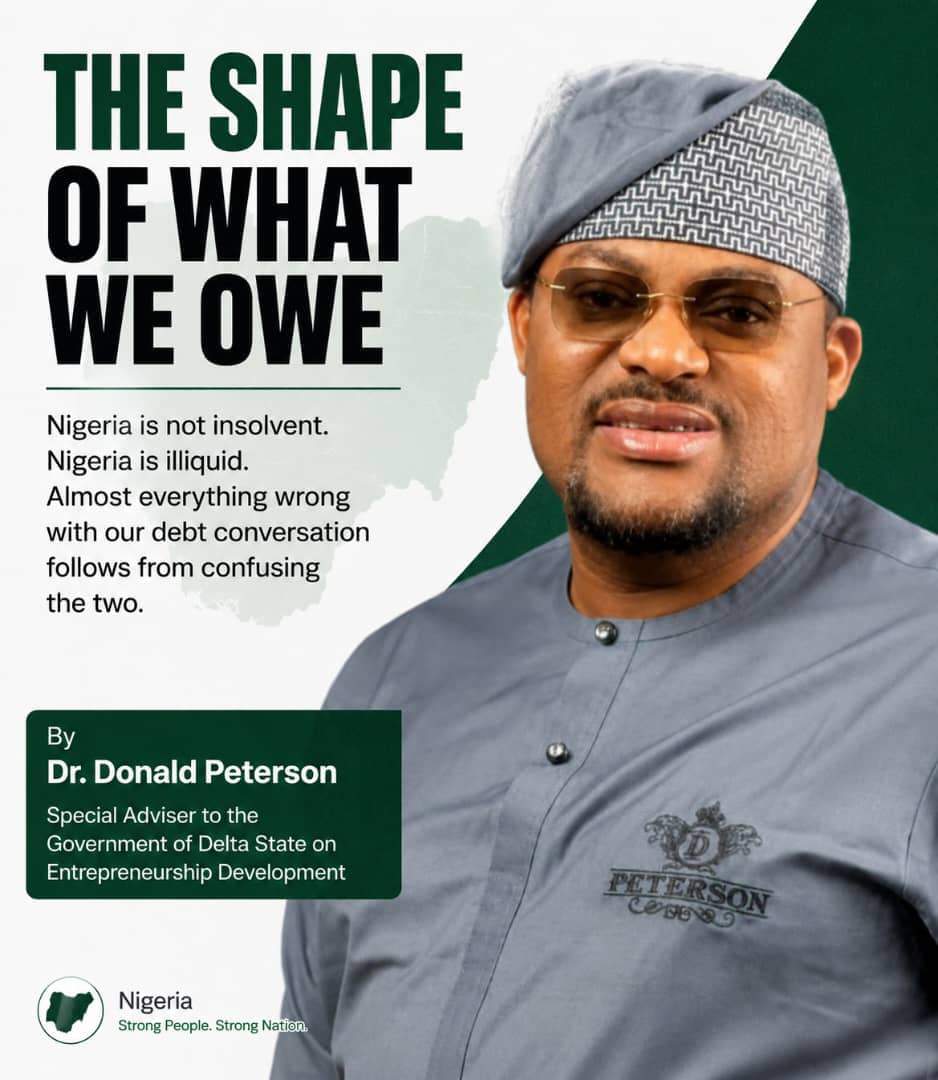
By Dr. Donald Peterson
Special Adviser to the Government of Delta State on Entrepreneurship Development
Nigeria is not insolvent. Nigeria is illiquid. Almost everything wrong with our debt conversation follows from confusing the two.
I. THE WRONG INSTRUMENT
Every quarter, when the Debt Management Office publishes, the country performs the same argument. One camp holds up the headline figure and calls it a catastrophe. The other holds up debt-to-GDP and calls it moderate. Each is measuring something real. Neither is measuring the thing that will actually determine whether Nigeria's public finances survive the next decade intact.
A debt stock is not a quantity. It is a structure: a distribution across currencies, maturities, coupons, creditor classes, and contingencies that nobody has bothered to write down. Two countries can carry identical debt-to-GDP ratios and face entirely different futures depending on who holds the paper, in what money, and when it falls due. Japan carries a ratio north of 200 per cent and sleeps soundly, because it owes yen to its own savers at rates near zero. Zambia defaulted at a fraction of that and spent four years in restructuring purgatory. The number was never the story.
Reinhart, Rogoff and Savastano gave this asymmetry a name two decades ago: debt intolerance. Emerging sovereigns face a much lower safe threshold than advanced ones, not because their economies are smaller but because their revenue bases are thinner, their currencies less trusted, and their track records shorter. The market does not price the ratio. It prices the credibility of the state standing behind it.
So let us stop arguing about the number and start describing the shape.
II. THE ANATOMY
As at 31 December 2025, Nigeria's total public debt stood at N159.28 trillion, roughly $110.97 billion at the official rate of N1,435.26 to the dollar. That is up from N144.67 trillion a year earlier. In 2021, the whole stock sat at N33.13 trillion.
That last comparison is the one shouted from podiums, and it deserves an honest reading rather than a dramatic one, because a large share of the increase is not borrowing at all. It is translation.
Think of a man in Warri who took a dollar loan in 2021 to buy a boat. He has not borrowed a cent since. But when he writes his position in naira, his debt has more than tripled, because the naira went from around N400 to over N1,400 to the dollar. Nothing about his obligation changed. The ruler he measures it with shrank. A very substantial portion of the move from N33 trillion to N159 trillion is precisely that, and pretending otherwise is either innumeracy or theatre.
Add the roughly N22.7 trillion of Ways and Means advances from the Central Bank, which were also not new money but an existing overdraft finally dragged onto the balance sheet where it always belonged, and much of the "explosion" turns out to be arithmetic and honesty catching up with each other simultaneously.
This does not make the number less real. It makes it differently real, and the distinction matters enormously when you are designing a remedy. You do not treat a fever the same way you treat a broken leg simply because both hurt.
Composition tells you more than the total. Of the N159.28 trillion, about N84.85 trillion is domestic and N74.43 trillion external, a split near 53 to 47. Within the domestic stock, FGN Bonds account for roughly N63.63 trillion and Treasury Bills about N13.85 trillion. The federal government carries about N80.49 trillion of the domestic debt. The 36 states and the FCT together carry about N4.36 trillion.
Pause on that domestic composition, because it is quietly the most encouraging fact in the entire portfolio and almost nobody mentions it.
Eichengreen and Hausmann coined the phrase "original sin" for the condition afflicting most developing economies: the inability to borrow abroad in your own currency, or at home for long tenors. It is the trap that turns every devaluation into a solvency crisis, because your liabilities are in dollars and your revenues are in something else. Nigeria has partially escaped it. More than half the debt is naira-denominated, and within that, term bonds outweigh short bills by better than four to one. The country can borrow at home, in its own money, for ten years and longer. That is not a small achievement. It is the difference between a bad quarter and a Zambian decade.
On the external side, at $51.86 billion, the creditor map bears almost no resemblance to the one in the national imagination. Multilateral institutions hold about $23.85 billion, of which the World Bank Group alone accounts for $19.89 billion, with $18.51 billion sitting in IDA, the Bank's concessional window. Eurobond investors hold about $18.55 billion. Every bilateral creditor combined holds about $6.72 billion, and China's share of that is roughly $5 billion.
Read that again, because it dismantles a decade of national anxiety in a single line. Nigeria's largest external creditor is not Beijing. It is the concessional arm of the World Bank, lending at terms no commercial institution would contemplate. Whoever eventually squeezes Nigeria will not be a foreign government. It will be a bond desk in London or Boston, staffed by people whose entire job is reading our budget documents more carefully than we do.
III. SOLVENT, BUT ILLIQUID: THE ARITHMETIC NOBODY RUNS IN PUBLIC
Here is where the standard conversation collapses on both sides, and where I want to spend some time, because this is the analytical heart of the matter.
There are two completely different questions you can ask about a debtor. Can he ever repay? That is solvency. Can he pay what falls due this month? That is liquidity. They are not variations on a theme. They require opposite treatments. A solvency problem needs a write-down. A liquidity problem needs a reprofiling, and applying the wrong medicine to either is how countries end up in restructurings they never needed.
Every trader in Alaba knows this distinction instinctively even if she has never heard the words. A woman with three shops, a warehouse and a rental property is not poor. But if her tenants pay yearly and her supplier demands cash weekly, she can go under while holding assets worth ten times what she owes. Her problem is not wealth. It is timing. Sell a shop under pressure and she solves a cash-flow problem by destroying a solvency position, which is the most expensive mistake in commerce and the most common one in sovereign finance.
Nigeria is that woman.
Take the solvency question first. The arithmetic governing whether a debt ratio explodes or stabilises is not complicated. If the nominal interest rate you pay on your debt is lower than the nominal growth rate of your economy, the ratio falls on its own, even while you run a deficit. Economists write this as r less than g. It is why Britain's post-war debt mountain melted without a single default, and why the same ratio can be terrifying in one country and irrelevant in another.
Run it for Nigeria. In the first quarter of 2026, nominal GDP at basic prices reached N110.79 trillion against N94.05 trillion a year earlier, a nominal expansion of 17.79 per cent. Now weigh that against the blended nominal cost of the portfolio. Roughly half the stock is external, priced between the near-concessional terms of IDA and the 8.63 to 9.13 per cent Nigeria paid on its November 2025 Eurobonds. The other half is naira paper, issued in a range that peaked at 18.47 per cent on the 364-day bill in January 2026 and has been drifting down since. Blend those honestly and the effective nominal interest cost sits comfortably below eighteen per cent.
So r is less than g. On the standard sustainability test, Nigeria's debt ratio is not on an explosive path. The IMF says as much when it calls the risk of distress moderate. This is not spin. It is the arithmetic.
And yet everyone can feel that something is badly wrong. So what is it?
It is the cash flow, and here the numbers turn ugly. Through the first nine months of 2025, federal debt service reached N12.52 trillion against revenue of N18.63 trillion, a ratio of 67.2 per cent. The Nigerian Economic Summit Group put the 2024 figure at 116.8 per cent, which means debt service alone exceeded total federal revenue and the government borrowed simply to stand still. The IMF projects federal interest payments consuming 53.7 per cent of revenue in 2026, having taken 53.2 per cent in 2025 and 40.8 per cent in 2024, with the ratio hovering near half through 2028. The World Bank's rough guidance for sovereigns at Nigeria's income level is somewhere in the low twenties.
This is a salary that arrives already garnished. Not a debt too large to repay, but a debt whose payment schedule collides with a revenue schedule that was never built to meet it.
Which brings me to the part of this that I think deserves far more discomfort than it currently receives.
If r is less than g, and the ratio is therefore stabilising, we should ask who is paying for that stabilisation. Because in Nigeria's case, g is doing the work, and a large part of g is inflation. Nominal growth of 17.79 per cent against real growth of 3.89 per cent means the remainder is price change. Which is to say: the debt ratio is being held in check substantially by the erosion of the naira's purchasing power.
That erosion is not free. It is a tax. It is the most regressive tax any state can levy, because it falls hardest on people who hold their wealth in cash and their savings in a bank account rather than in land, dollars or equities. The pensioner in Ilesa whose N80,000 monthly stipend buys half of what it did three years ago has paid it. The teacher in Kaduna has paid it. The trader who keeps her working capital under a mattress has paid it. None of them filed a return. None of them appear in the FIRS database. They were taxed anyway, invisibly, through the price of garri.
So when officials cite an improving debt ratio, the honest follow-up question is: improving because we collected more, or improving because the currency did the collecting for us? For much of the last three years, uncomfortably, the answer has been the latter.
That is precisely why the reform agenda that follows matters, and why it cannot wait. The entire task is to migrate the burden of debt sustainability off the inflation channel, where it is borne by the poor without their consent, and onto the revenue channel, where it is borne by those with capacity and voted on in public.
IV. WHAT THE STABILISATION ACTUALLY PURCHASED
I want to be careful here, because our commentary has a lazy habit of treating fiscal criticism and political credit as mutually exclusive. They are not, and the essay you are reading depends on both being true at once.
The most defensible thing that can be said about Nigeria's economy in mid-2026 is that the macroeconomic stabilisation pursued since June 2023 has worked in measurable ways, and that the specific asset it produced, credibility, is now the working capital for the structural reform still outstanding. Stabilisation is not the destination. It is the deposit that lets you take out the mortgage.
The evidence is on the record rather than in the rhetoric.
Begin with the ratings agencies, the least sentimental judges available. Fitch upgraded Nigeria to B on 11 April 2025, citing increased confidence in the government's reform commitment since the shift to orthodox policy in June 2023, and naming exchange rate liberalisation, monetary tightening, subsidy removal and the steps to end deficit monetisation. Moody's followed on 30 May 2025, lifting Nigeria from Caa1 to B3, its first upgrade of the country since 2019. S&P completed the set on 15 May 2026, raising the sovereign from B- to B with a stable outlook and the national scale to ngA+. Three houses, three independent methodologies, one conclusion. That convergence has not occurred for Nigeria in a very long time.
Then look at what the market did with that judgment, because pricing is where credibility stops being an opinion and becomes a number. In December 2024, Nigeria paid 9.625 per cent for six-and-a-half-year Eurobond money and 10.375 per cent for ten-year. By November 2025 the Republic raised $2.35 billion against an order book exceeding $13 billion, an oversubscription near 477 per cent, pricing the 2036 tranche at 8.63 per cent and the 2046 at 9.13 per cent. Between 100 and 175 basis points of improvement in eleven months, achieved through considerable geopolitical noise, with participation from the United Kingdom, North America, Europe, Asia, the Middle East and Nigeria itself.
Put that in terms anyone can feel. If you refinanced a mortgage and your rate fell by a point and a half in under a year, you would not 6describe it as a technicality. On a billion dollars of ten-year money, that spread is worth well over a hundred million dollars in interest. Reform credibility is not an abstraction. It has a price, and Nigeria's fell.
The external position corroborates. Gross reserves stood near $33 billion in 2023. By March 2026 they approached $50 billion, and by 17 July 2026 they reached $52.52 billion, about eleven months of import cover against an international benchmark of three. Average monthly foreign exchange turnover reached roughly $8.6 billion in 2025, with April 2026 alone recording close to $10 billion of market supply. The naira, having found a level, has since firmed, trading around N1,372 in May 2026 against the N1,435 used for the December 2025 debt conversion. A currency that appreciates while reserves accumulate is a currency the market has stopped shorting.
Inflation, the reform's cruellest political cost, has broken. Headline peaked at 33.7 per cent in April 2024. By June 2026 it stood at 15.91 per cent, core at 15.92 per cent from 16.82 per cent the prior month, and the twelve-month average down to 17.63 per cent, a sixth consecutive month of moderation. The Central Bank attributes the core moderation largely to exchange rate stability, which is to say the FX reform is finally paying out in the one place households register it.
Growth has followed, and its composition matters more than its headline. Real GDP grew 3.89 per cent year-on-year in Q1 2026, up from 3.13 per cent a year earlier. Non-oil activity grew 3.94 per cent against 3.19 per cent and now constitutes 96.08 per cent of real output. Agriculture recovered to 3.15 per cent from a near-flat 0.07 per cent. Finance and insurance expanded 8.54 per cent, construction 6.38 per cent, transportation and storage 7.41 per cent. All of it achieved while average crude production fell to 1.55 million barrels per day, below both the prior quarter and the year-ago period.
That last sentence is the one to underline. Nigeria grew while oil shrank. For an economy whose entire post-war political history has been an argument about petroleum rents, that is not a statistic. It is a structural inflection, and it is the outcome two decades of development plans called for and never produced.
On the fiscal side, the tax legislation effective 1 January 2026 is the first comprehensive overhaul in more than three decades. Executive Order 9 of February 2026 requires the NNPC to remit a larger share of earnings to the Federation. S&P projects the debt-to-revenue ratio falling toward 338 per cent in 2026 from close to 500 per cent in 2023, and government revenue reaching 12.4 per cent of GDP from 7.3 per cent in 2023.
Ending Ways and Means monetisation deserves separate mention, and by my reckoning it was the single most consequential decision of the period precisely because it was the least popular. Printing money to fund deficits is not a financing method. It is a levy, imposed without legislation, on everyone who holds naira. It was the mechanism by which fiscal indiscipline in Abuja was converted into household poverty in Bauchi. Closing it hurt badly. It also stopped the bleeding, and the disinflation now underway is the delayed dividend.
None of which means the work is done, and I would rather say so plainly than have a reader say it for me. Growth of 3.89 per cent against population growth near 2.5 per cent leaves per capita improvement thin. Inflation at 15.91 per cent is a moderation, not a relief, and real wages have not recovered what they surrendered. Economists have fairly observed that the aggregate numbers have run ahead of what households can feel, and a family that cannot afford beef does not care about a ratings upgrade.
But that is the argument rather than a refutation of it. Stabilisation buys you credibility. Credibility is a wasting asset. What follows is a proposal for spending it before it depreciates.
V. FOUR STRUCTURAL FAULTS
1. A budget built on revenue that never arrives
This is the engine of the entire cycle, and it is remarkable how rarely it is named as the primary defect rather than a secondary irritation.
Between January and July 2025, the federal government earned N13.67 trillion against a prorated target of N23.85 trillion, a shortfall of N10.19 trillion or 42.7 per cent. Oil revenue came in at N4.64 trillion against N12.25 trillion expected, missing by 62.2 per cent. That gap was not closed by spending less. It was closed by borrowing more.
The 2026 budget reproduces the architecture at greater scale: expenditure of N68.32 trillion, revised up from an initial N58.47 trillion, against projected revenue of N36.87 trillion. A deficit of N31.46 trillion, about 6.41 per cent of GDP, against a Fiscal Responsibility Act ceiling of 3 per cent. New borrowing revised from N17.89 trillion to N29.20 trillion. Debt service budgeted at N15.81 trillion. BudgIT's reading is that the government can fund only about 53.9 per cent of its own budget from actual revenue.
Consider what this would mean in a household. A man earns N400,000 a month and builds his family's budget around N740,000, on the assumption of a promotion he has been promised for four consecutive years. Each month he covers the gap with a new loan. His creditors are not troubled, because his employer is solid and his house is worth more than he owes. He is, technically, solvent. He is also, by any sensible standard, in serious trouble, and the trouble is not his salary. It is his forecast.
A deficit rule breached by more than double, every year, without consequence, is not a fiscal rule. It is stationery.
2. Obligations the state has written but never priced
The Nigerian Bulk Electricity Trading Company owes generation companies roughly N6.6 trillion, accumulated through unpaid tariffs and subsidy gaps. It appears nowhere in the N159.28 trillion.
The right way to understand this is not as forgotten debt but as an option the state has sold without collecting a premium. When government guarantees a tariff it cannot fund, or backstops a project vehicle, or lets an agency accrue arrears, it has written the economic equivalent of a put option: somebody else holds the right to hand it a liability at a moment of their choosing, usually the worst one. Insurers price such things for a living. The Federal Republic writes them for free, in volume, and records none of them.
Multiply across the dozens of government-owned enterprises with thin disclosure, add contractor arrears, pension liabilities, promissory note programmes and issued guarantees, and the honest conclusion is that nobody in Abuja can tell you within a few trillion naira what the Federal Republic owes. That is not a data problem. It is a governance problem wearing a data problem's clothes, and no portfolio can be managed before it has been counted.
3. Debt management that is procurement rather than portfolio management
The DMO is, by most measures, a capable institution. Its Medium-Term Debt Management Strategy for 2024 to 2027, built with World Bank and IMF technical support and approved by the Federal Executive Council

Comments (0)
No comments yet. Be the first to share your thoughts!
Leave a Comment